The XPat Journal The yearly Health Care Special will come out on June 11th. June 2010 to advertise in this issue
News
Just released
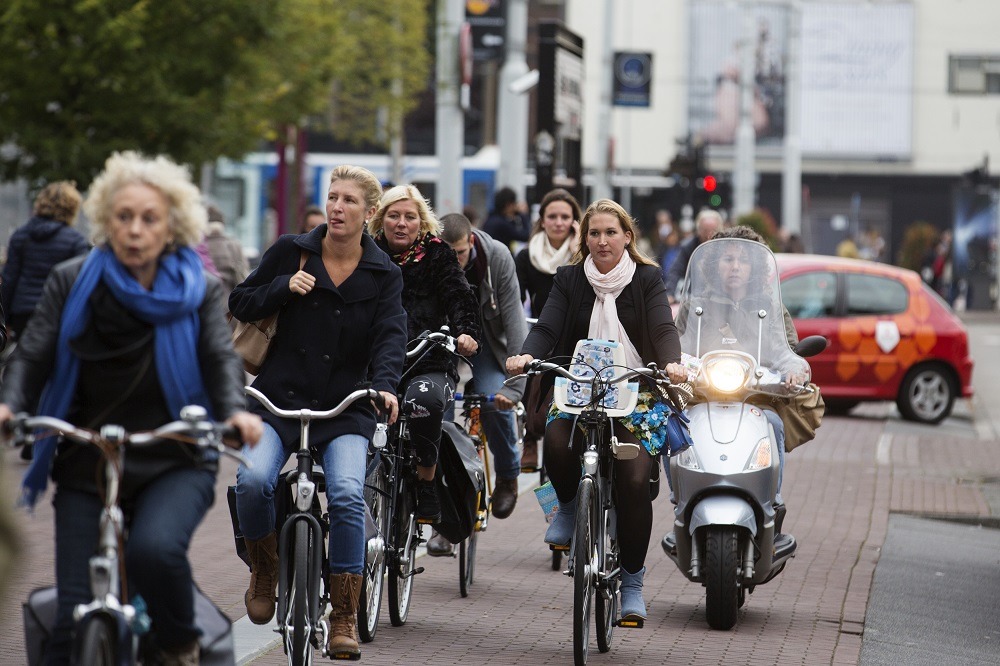
Our latest book Bicycle Mania, was launched on November 14 Nov 14th, 2009 For more information
News
Bicycle Mania Photo Contest
We are happy to present the proud winners of the Bicycle Mania Photo Contest. Feb. 5th, 2010 The Winners
The Netherlands in a Nutshell
The windmills of your mind are not playing tricks on you. You have (or your Dearly Beloved has) accepted that job in the Netherlands. The dust, created by the whirlwind consequences of this decision, has started to settle and you are beginning to wonder what type of country you have come to. Having read about culture shock in the preceding introduction, you now know that the best step towards familiarizing yourself with this new culture is knowing more about it. First off, relax in the knowledge that the Netherlands has one of the highest standards of living in the world. But what kind of people are the towering Dutch? What about their government and economy, religion, the climate, their customs and etiquette, particular ways of celebrating holidays and special occasions, and their oh-so-challenging language? This chapter will help you navigate through some of the canals of these riddles. In the end, the effort you put into rowing through uncharted territory will matter more than which way the wind is blowing.
Poldermodel
A piece of land that is completely surrounded by a dike for the purpose of protecting it against high waters is called a polder in Dutch. You can find them in all shapes and sizes. The largest in the Netherlands, Flevoland (also the Netherlands’ youngest province), measures 48,000 hectares. The management of such a polder requires a tight cooperation between the users. The smallest mistake can result in disaster, as a dike is as strong as its weakest point.
Life behind the dikes has influenced the Dutch culture. It might be going too far to say that it has made the Dutch a democratic people, however, it is clear that they are partial to detailed agreements, to which they must strictly adhere. Foreigners never fail to notice the large degree of organization and planning in Dutch society.
This coming together to reach a consensus, this give and take in all the various areas, all characterize Dutch society and Dutch politics. It has resulted in, for instance, the tolerance of drugs and the legalization of prostitution. This attitude can be summarized in a new word, invented by the British press in 1997: Poldermodel. This word represents all that makes Dutch society a successful one: a society in which the people literally and figuratively try to keep their feet dry.
The Dutch Political System in Brief
The Government
The Dutch government is what one calls a ‘monarchical government’, meaning that it is not only comprised of the ministers and the state secretaries, but also the monarch, Queen Beatrix. The constitution determines how the powers are divided between the Queen and the other institutions of the government. The Queen, who has no political responsibility, is not accountable to Parliament.
The Cabinet
The cabinet’s responsibilities are: preparing and implementing legislation, overseeing the local government, carrying out the day-to-day business of government and maintaining international relations. The observant follower of Dutch politics will notice that the number of ministers tends to change from one cabinet to the next.
The Parliament
The Netherlands has a representative democracy and its parliament (Staten Generaal) is made up of two chambers: the Upper House (Eerste Kamer), whose 75 members are elected by the members of the provincial councils; and the Lower House (Tweede Kamer), whose 150 members are elected directly by the people.
The Political Parties
The Dutch Lower House of Parliament is elected by proportional representation and currently there are ten political parties in the Lower House. Traditionally, the three largest are the PvdA (Labor Party), the CDA (Christian Democrats) and the VVD (Liberals). However, as of the most recent election, the third largest party is the SP, or Socialist Party. The VVD has now been relegated to fourth place.
Customs and Etiquette
Before you put your proverbial foot in your proverbial mouth, here are some lessons picked up at the school of hard knocks, where the price of tuition is a lot higher than learning it here.
Personal Social Space Dutch social space is determined in great part, it is deemed, by the lack of physical space that is available in Holland. Granted, everything and everyone is very close together. Holland has one of the highest average population densities in the world: 395 inhabitants per km2.
Theory has it that the Dutch compensate for this lack of physical space by making their personal social space wider, so that they can better deal with the problems of living in such a crowded society.
Hospitality Gifts
A visit to someone’s home invariably calls for a hospitality gift. Flowers, cookies, or candy are almost always appropriate. If you think that your host(ess) might be dieting or diabetic, take flowers. Flowers are quite inexpensive in Holland, as the world’s largest flower exporter, and are a welcome present.
(Hint: buy flowers with the blooms still closed. Not only do they last longer, but fully open flowers have an aura of cheapness about them. The impression will either be that the florist took advantage of your being a foreigner and palmed them off on you, or you took advantage of their lower price to skimp on your hospitality gift.)
Special Occasions – The Dutch Way
Birthdays
Nearly all Dutch people celebrate all of their birthdays with great enthusiasm. On that day they can usually expect family and friends to visit them at home, or to telephone or send a birthday card. It is considered rather anti-social for a person to ignore his or her own birthday (verjaardag). Contrary to American custom, for example, where the birthday celebrant is catered to, the Dutch celebrant plans and hosts the festivities, inviting and catering to friends and family, most often at home. The custom in the workplace is to bring pastries for colleagues at work to enjoy over coffee. Likewise, children bring treats to school for all their classmates.
Birthday calendars (verjaardagkalenders), which are usually hung prominently in the bathroom, help people to keep track of the dates on which they have to pay visits or send cards. A word of advice: don’t overlook a Dutch person’s birthday; such forgetfulness borders on insolence.
Curiously, it is customary to congratulate not only the person whose birthday it is, but also his or her relatives, friends and even neighbors. To say ‘Congratulations (Gefeliciteerd!) on the birthday of your brother-in-law’ would be quite normal. By the same token, don’t be caught off guard if someone congratulates you whenever it’s your spouse’s or child’s birthday. You’ll now understand what you did to deserve the kado's!
Typical Dutch Festivities
A selection:
Koninginnedag – the Queen’s Birthday: April 30th
Although not necessarily known to be royalists, the Dutch are extremely fond of their queen. Throughout history, the Dutch Royal Family has been very popular and their birthdays have been celebrated with enthusiasm. You can celebrate the Queen’s birthday either by visiting one of the two annually chosen towns or cities the Queen visits on this day – and witness some true old-fashioned entertainment – or you can visit some of the bigger cities. Amsterdam, in particular, goes all out on this day, with a vrijmarkt, a free market that fills the streets in the center of Amsterdam with stands run by people age 5 – 105, selling anything and everything. Another option is to visit the traditional koninginnemarkt (Queen’s Market) of your own town, where the locals sell just about anything for a song, a great opportunity for bargain hunters and antique buffs.
Trick or Treats – Sint Maarten
Increasingly, the trick or treats day of November 11 is being reintroduced. On this day, children (often accompanied by parents) come by your door, carrying lanterns and singing songs. This day is a ‘treats’-day – no tricks – the treats being anything from tangerines to cookies to candy. The children do not get dressed up for this occasion, either; it is a simple – though friendly and gezellige – neighborhood event.
Sinterklaas
Throughout the centuries, Sinterklaas has been considered the patron saint of children, as well as traders. He arrives somewhere in the middle of November, together with his assistant, Zwarte Pieten (historically of Moorish descent) and visits schools, offices and towns, until on the evening of December 5th, on which evening he brings children gifts that are surreptitiously dropped off in a sack on the doorstep of each household. This is the family holiday in the Netherlands.
For useful addresses and websites, please use the info-link button at the topof this page
More on these subjects can be found in The Holland Handbook 2009 - 2010